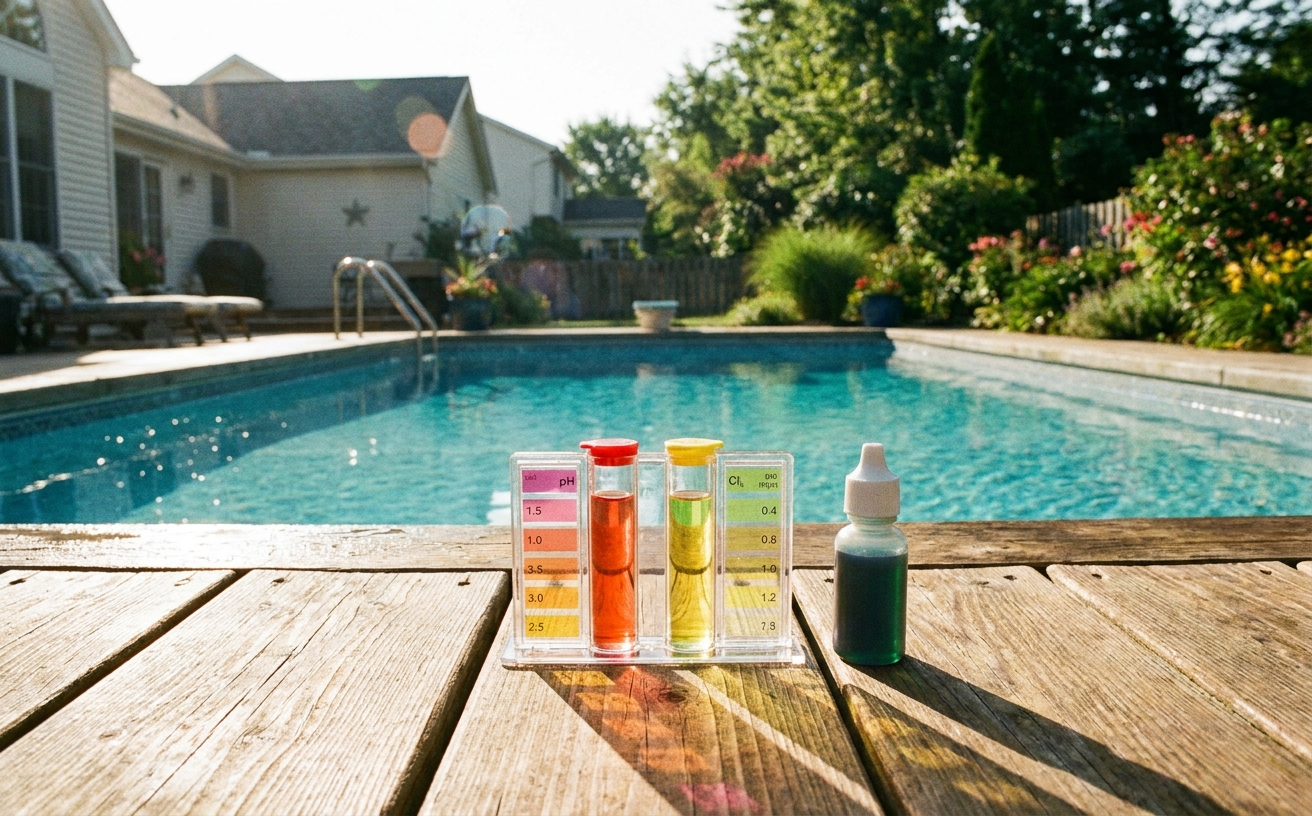
Pool chemistry intimidates new owners because it feels like there are dozens of numbers to track. In reality, five measurements determine whether your pool is healthy or heading toward trouble. Everything else is either a derivative of these five or a secondary concern that only matters when the primary five are out of range.
Get these five right, and ninety percent of pool problems never appear. Ignore any one of them, and the others become harder to manage because water chemistry is an interconnected system where each parameter affects the others.
Free Chlorine: The Active Sanitizer
Free chlorine is the chlorine available to kill bacteria and oxidize contaminants. It is the single most important number in your pool. Without adequate free chlorine, nothing else matters because the water is not sanitary.
The target range is one to three parts per million for most residential pools. Below one ppm, bacteria and algae can establish. Above five ppm, the water becomes irritating to skin and eyes, though it is not dangerous.
Free chlorine is consumed by sunlight, organic contaminants, and ammonia compounds. On a hot, sunny day with swimmers in the water, free chlorine can drop from three ppm to zero in a few hours. This is why regular testing and timely additions are essential, especially during peak swimming season.
pH: The Balance Point
pH measures how acidic or alkaline the water is on a scale of zero to fourteen. Pool water should be between 7.2 and 7.6. This range maximizes chlorine effectiveness while remaining comfortable for swimmers.
pH affects everything. At pH 7.0, chlorine is nearly one hundred percent active. At pH 8.0, chlorine is only about twenty percent active. A pool with correct free chlorine but high pH is effectively under-chlorinated because most of the chlorine is in a less active form.
Low pH causes eye irritation, corrodes metal fittings, and etches plaster surfaces. High pH reduces chlorine effectiveness, promotes scaling, and makes the water feel slippery. pH is the lever that controls how well all the other chemicals work, which is why it should always be the first parameter you adjust.
Total Alkalinity: The pH Anchor
Total alkalinity is the buffer that prevents pH from bouncing. It acts as a shock absorber for pH changes, keeping the water stable between adjustments. The target range is eighty to one hundred twenty parts per million.
Low alkalinity causes pH to swing wildly with each chemical addition. Add chlorine, and pH drops. Add a swimmer, and pH rises. The water never stabilizes, and you are constantly chasing a moving target.
High alkalinity makes pH resistant to change, which sounds good until you need to lower pH and find that the standard dose of acid has no effect. You add more acid, still no effect. Then the alkalinity finally releases and pH crashes, dropping far below the target. For a comprehensive explanation of how alkalinity interacts with every other parameter, iGarden’s pool chemistry handbook provides detailed adjustment protocols based on actual test results.
Cyanuric Acid: The Sunscreen
Cyanuric acid, often called stabilizer or conditioner, protects chlorine from being destroyed by ultraviolet light. Without it, chlorine in an outdoor pool degrades by ninety percent within two hours of direct sunlight. With proper cyanuric acid levels, that same chlorine lasts six to eight hours.
The target range is thirty to fifty parts per million. Below thirty, chlorine burns off too quickly in sunlight. Above one hundred, the chlorine becomes over-stabilized and loses effectiveness, a condition called chlorine lock.
Cyanuric acid does not dissipate. It accumulates over time as you add stabilized chlorine products like trichlor tablets. This is why pools that use trichlor exclusively often develop excessive cyanuric acid levels after a few seasons. The only way to reduce it is to drain and replace water.
Calcium Hardness: The Structural Protector
Calcium hardness measures the amount of dissolved calcium in the water. The target range is two hundred to four hundred parts per million for plaster pools, and one hundred fifty to two hundred fifty for vinyl and fiberglass pools.
Low calcium causes the water to draw calcium from pool surfaces, etching plaster and damaging grout. High calcium causes scaling on surfaces, inside pipes, and on heat exchangers. Both extremes are expensive to fix.
Calcium hardness is the most stable of the five parameters. It changes slowly and rarely needs adjustment more than once or twice per season. But ignoring it entirely leads to long-term surface damage that shortens the life of the pool shell.
How the Five Interact
These five parameters do not operate independently. Adjusting one affects the others, and the order of adjustment matters.
- Always adjust total alkalinity first, because it stabilizes pH
- Adjust pH second, because it controls chlorine effectiveness
- Adjust free chlorine third, now that pH is in the correct range for maximum activity
- Check cyanuric acid periodically, as it accumulates and cannot be reduced chemically
- Test calcium hardness monthly and adjust if it drifts outside the target range
Following this order prevents the common mistake of adding chlorine to water where pH is too high, which wastes chlorine because it is less active, which leads to adding more chlorine, which raises pH further, which makes the chlorine even less active. It is a cycle that breaks only when you fix pH first.
Testing Frequency
Free chlorine and pH should be tested twice a week during the swimming season, and once a week during the off-season. Total alkalinity should be tested weekly. Cyanuric acid and calcium hardness should be tested monthly.
After heavy rain, heavy use, or any event that might have affected the water, test immediately. The sooner you catch a drift, the easier it is to correct. A slight pH shift takes one small dose of adjuster. A major pH crash takes multiple corrections over several days.
The five numbers are not difficult to understand. They are difficult to remember consistently. Build a testing habit, follow the adjustment order, and your pool stays in range with minimal effort. Skip the testing, and you will spend more time fixing problems than preventing them.